

Clarion Housing Fails Residents
Updated: May 28
A story about homes with pests, leaking ceilings, no heating or hot water, and emergency exit doors that don't open, all provided by a landlord backed by local and national government in London of the 2020s

I was working on a listicle titled, Five things that boost your mood, when someone knocked on the front door. It was eleven o’clock on Friday, 24 March 2023, and I didn’t appreciate the interruption, hoping to finish the piece before lunch, but the person wouldn’t leave.
“Can I help you?” I asked, opening the door in leggings and a work blouse I wore for a Zoom meeting with colleagues I'd had that morning.
“We’re shutting off the gas,” said the man in an engineer’s overalls with a Clarion Housing logo stitched on the breast pocket. Someone had drilled through a pipe in the neighbouring block; for safety, they had to isolate the whole street. “Should be back in an hour or so,” he said.
I shut the door and wrapped myself in a blanket, braced for a couple of hours without heating or hot water, regretting I didn’t cook lunch when I had the chance.
The visit had disrupted my flow, and I struggled getting back into writing about gratitude practice, which topped my list of things that improve one's wellbeing. It was my first assignment as a health editor for a magazine published by a national organisation dedicated to medical research. The job brought me to London, where I now lived with my sister in her flat.
It was already dark when I finished a draft. Gas had not come back. Instead, a folded A4 piece of paper had come through a letter box. I picked it up from the doormat.
It was a letter to the residents from Clarion Housing, the biggest provider of social housing in the United Kingdom, and manager of the six blocks of flats down the street where I lived.
Ms Jacqueline Thomas, Clarion’s Head of Housing, was advising me that due to an incident with a contractor earlier that day there was no gas supply to any of the properties along the street. The main gas supply had been capped, and it was safe to stay in my home, but there was a “significant” amount of work to do and investigations were already “underway”.
Ms Thomas provided no timeline for the gas to be reconnected but offered some interim solutions. Clarion Housing would provide mobile heaters “as soon as possible”. They’d arranged with a nearby restaurant for residents to have a hot meal (though it wasn’t clear at whose expense). A leisure centre located a 20-minute walk away had agreed to welcome anyone wanting to have a hot shower.
Ms Thomas appreciated it was a “major” inconvenience and said staff would be available to answer questions over the weekend. She provided phone number for the Neighbourhood Warden who could "provide further support". She said she’d informed Merton Council and Siobhain McDonagh, our local Member of Parliament.

Clarion Housing fails to show urgency
I was irritated that I couldn’t take a hot bath after spending a day inside a flat that very quickly got cold, but I also tried to be understanding. This was, after all, an incident, and incidents happen. And when they happen—and especially when they involve gas—the right steps must be taken to repair the damage and bring everything back online. This takes time.
I wasn’t looking forward to a weekend without heating, hot water, or home-cooked meals, but I believed that people responsible for the safety of the estate would spend this time doing everything in their power to bring back the gas supply.
But no one did any repairs on Saturday.
At Sunday lunchtime, when the novelty of watching Netflix under a duvet while wearing a woollen hat in bed had worn off, I left the flat to ask Clarion staff for any updates. I found them in a little room near the garages, huddled around a couple of electric heaters.
They didn’t have any updates.
“And when will you…?” I asked, terrified at the prospect of spending another day in a flat that had now gone cold and was feeling increasingly damp.
“Soon,” they promised, offering me a heater. I scanned the faces of my neighbours who had gathered outside the little room. They were as unsatisfied as I was, but we all just took our heaters and went home, trusting, perhaps, that the Clarion staff were following an emergency response plan, and all would be well soon.
Contacting a Member of Parliament about an issue
Back in the flat, I boiled a kettle and filled a hot water bottle. I changed into a pair of brushed cotton joggers and a flannel shirt, and I matched some woollen socks to my woollen hat. I went to bed, hugging the hot water bottle. Unable to fall asleep, I contacted both the Council and our local Member of Parliament (MP) Ms McDonagh, describing the situation.

The council told me that they couldn’t log my complaint against Clarion Housing because the Association was not a council service. They advised that I logged the complaint with Clarion Housing directly, which I didn’t think would accomplish anything. The next update came at the end of Tuesday, 28 March.
Ms Thomas was “sorry” to say that it would take “some time” before gas supply could be restored. She was “aware” of the impact the disruption had on the residents. Clarion staff were knocking on doors and answering questions from their on-site office on Friday, Saturday, and Sunday, and would continue to do so.
The previous Friday, a gas pipe was damaged during ventilation works in one of the blocks, so the gas main had to be shut down. The damaged pipe was repaired already on that day and specialist contractors had been asked to advise on how to safely restart the gas. Following this advice, Clarion had to “complete due diligence works” to the wider gas network before reinstating the gas supply. This would be done in two stages.
Stage 1: Inspecting and testing all gas pipework outside of the blocks up to where it enters the buildings. Pipes had to be isolated and pressure tested to confirm they comply with industry standards.
Stage 2: Testing the internal pipework in each block, which required access to each flat.
They’d already began the works which were due to complete by March 30.
I sighed with relief. The end was in sight!
Clarion were continuing to offer portable heaters, which the residents could collect from their on-site office. Hot plates and mini-ovens were now being made available too. We could still take a shower at the gym, and the leisure centre was now opening their laundry facilities to us. Clarion management were also offering a voucher of £98 to cover the cost of the extra electricity required for running all the replacement devices.
Clarion Housing fails residents on safety
I read the letter from Ms Thomas several times, wondering if Clarion were making things up as they went along. Needing to test the pipes to confirm they complied with industry standards? Shouldn’t they have been doing this all along while servicing the buildings?
The portable "heaters" cooked the air, instead of heating it, and the costs of running just two felt higher than the value of the voucher. Plus, they did nothing to help keep the flat dry and I was starting to feel a little off whenever I woke up after a night in what felt like a bats' cave.
After nearly a week of this, feeling rough, I decided to check into a hotel for a couple of nights to get some sleep and give myself a chance to recover from the damp that was seeping into my lungs. As I packed, I got a reply from the office of Ms McDonagh, signed by a person called Helen, dated 29 March.
Helen shared with me an email she’d sent to Clarion, expressing concerns that the gas supply had not been reinstated to our blocks for nearly a week. Although initially their office was informed gas would be reconnected by Monday, 27 March, it was now becoming apparent that it would take some additional days, if not weeks, for this to be the case.
Helen went on to ask how Clarion would determine which residents were “vulnerable” and what support would be offered to those with limited mobility and other needs. She commented on the value of the electricity voucher, which didn’t seem like enough money to cover the extra costs, especially if these measures were to continue.

Having checked myself into a hotel, I shared my timeline of the events, noting that the Monday deadline had always been unlikely, given that no neighbour had witnessed any inspection or repair works over the weekend. I noted that the cost of running a hot plate and electric heaters was £2/hour, so the mileage on the £98-voucher was limited. I also reported that, according to what the various engineers working on the estate had told me during the week, it was unlikely that gas could return before Easter, April 9.
As I wrote this, I began to wonder.
People in six blocks of flats had their homes turned into something unsuitable for human habitation and the liable administrators were suggesting doing laundry at the gym and sharing “concerns”? What year was this? In what country? And who had the residents’ back?
Later that night, I contacted local and national press, whose journalists had previously covered stories about Clarion Housing in particular, and the UK-wide housing crisis in general. Just a month before, the Guardian had run a piece titled: Rats, mould, damp: One woman’s story reveals the ugly truth about the UK’s biggest housing association.
I knew they wouldn’t run another so similar a story so soon, but others? Small, local publications, or those focused on housing and social issues? They were probably already overstretched; I didn’t get any response.
No heating for a few weeks
Arriving home for work the next day, 30 March, I found further updates from Clarion on my doormat. An unidentified writer of the letter stressed first and foremost that the estate was “entirely” safe.
I clenched my teeth, thinking we had “entirely” different definitions of “safe” housing.
They went on to explain that the tests they had done were “not positive”, which meant that most residents would be without gas for longer than they’d “originally thought”. They knew this was “difficult” and would work closely with us to make “alternative arrangements” to support us and our families.
The letter gave information on their “initial plan”, saying further details would be shared on Tuesday, 4 April. Until then, the gym’s washing facilities were available to us. What's more, Clarion engineers were now also starting to install electric water boilers in each flat on the estate—more on that we’d hear on Wednesday, 5 April—while investigating other options for providing hot water.
They were "sorry" for the impact this issue was having on us and our families.
Who can help with a housing issue?
I considered my options. Sitting at a laptop, I stared at the Google search strip, tapping my fingers gently on the keyboard to gather my thoughts—what do I look up?
The shortlist of my questions included:
Which was the UK institution tasked with looking after residents forced to live under such conditions?
Which was the office that had oversight over Greater London landlords that could put pressure on Clarion to provide residents with better temporary options and, in the long-term, hold them to account for allowing the estate (where people lived!) to fall into disrepair?
Who should have been notified about Clarion’s failure to regularly inspect and repair the gasworks?
On a personal level—who was going to reimburse my sister for a property, which she owned and which had now lost its value both as a place to live and as something to sell before moving somewhere else?
And finally—did anyone even care?
No editorial office expressed any interest in the story, and I never saw any journalist on site. The Merton Council had already told me they weren’t within their remit to act, and the responses from Ms McDonagh’s office seemed limited to the expressions of concern, which couldn’t translate into any meaningful action.
Seeking personal legal advice on my sister's behalf, I didn’t know where to turn to. She owned a flat that was part of a council estate; her agency was limited to within the four walls of her property, but the walls themselves and everything inside and around them were under Clarion, over which she had no control.
My questions bounced between the Housing and Property Ombudsmen. I wasn’t a social housing tenant, so the Housing Ombudsman couldn’t help me. But my complaint wasn’t about a letting or an estate agent, so the Property Ombudsman couldn’t help me either, and the best thing I could do was follow the Clarion complaints process.
It seemed that, if Clarion chose never to reinstate the gas, they could very well do so, leaving me without a home or a recourse.
Why are UK’s homes in disrepair?
Trying to understand how it was even possible that, in 2023 on the edge of London, a seemingly minor incident with a pipe resulted in what ended up being six months of construction work, affecting gas pipes in six blocks of flats, including the underground network, I chatted to the various engineers and officials that milled around the estate.
The unofficial answer repeatedly given was that the estate had been scheduled for demolition. And while I couldn’t confirm that the six blocks had been condemned—or indeed that the decision had been reversed—rumours about this had been circulating for years among residents, fed largely by the fact that nothing ever got fixed.
Aside from the gas supply disruption, among the long-standing complaints was a leak in my flat that had been recurring at least since 2011 (according to the emails I’d saved), and now water was also dripping in the hallways. At night, I heard mice scratching inside the walls, and I’d wake up in the morning to the evidence of their rummaging through my seeds and nuts drawer. Mould was rife in the common areas.
The extent of disrepair was such that prospective buyers couldn't get a mortgage for any flats listed on the estate.
In the spring of 2024, when my sister decided to leave her home after more than fifteen years, a local real estate agent came to appraise the flat. He told her that she could sell to cash-only buyers, which could have delayed the sale or precluded it altogether, leaving us stuck in a building whose structural soundness was dubious. But by summer, Clarion Housing had bought the flat. By September 2024, we’d moved.
Temporary accommodation
Back in March 2023, I went to Clarion’s on-site office and demanded to speak to Ms Thomas, Clarion’s Head of Housing.
I explained my situation: I had been living without heating for a week now, also working from home. The portable heaters I was given did nothing to heat the flat, which was now feeling very damp. I had no friends or family in the area that I could stay with and couldn’t leave the country to join my family in Poland without taking unpaid time off work.
I was feeling increasingly unwell from the cold and damp and had checked myself into a hotel the day before, paying £100 per night. I wanted Clarion to reimburse me for the expense and provide me with temporary accommodation until they made my flat habitable again.
Ms Thomas wrote down my name in a little notebook she took out of the pocket of her Clarion-branded jacket. She said someone would call me “soon” to arrange temporary accommodation and reimburse the money I’d already spent. By the afternoon, someone did indeed call me, asking about my health vulnerabilities, and the hotel of choice.
I was eventually booked into a premium double room at Travelodge, with food vouchers for breakfast and dinner, which remained available for six weeks, when I cancelled it after gas had been reconnected to my flat.
Months of construction work
By mid-April, Clarion engineers arrived to install a temporary electric boiler in my flat, which required gutting the cupboard adjacent to the bathroom, which had been converted into a wardrobe (the gas boiler lived in a similar cupboard elsewhere in the flat). Having emptied the cupboard and watching the damage being done by the works to its insides, I thought about energy.
I’m not an electrician, but I wondered whether anyone had signed off on this increase in the use of electricity. The grid was already supplying electric heaters and hot plates to all flats in the building and would now also supply the temporary boilers, on top of the regular appliance use, all of which may have placed excessive demands on the network.
I emailed Ms Thomas who said that the electric network was perfectly safe, which didn’t sound right to me, but I didn’t follow up. By this point, I was frazzled from the chaos and though my boss expressed “understanding” and “compassion”, I felt increasingly unfit for work and had to channel all my energies into keeping a job.
The follow-up happened without my input.

Next time I opened the door to an engineer, it was an electrician, arriving to replace the switchboard, which he said hadn’t been up-to-code for several years. The temporary electric boiler could only be installed after the switchboard had been changed. He checked the cables around the flat and concluded that the work would be contained to the box itself, as the wires were good enough to keep, and the work inside the walls would be minimal.
After a few days, I could finally have a hot bath in my own bathroom.
By May, the gas supply had been reconnected to my block, and the temporary boiler had been removed. After moving my things back into the cupboard-turned-wardrobe, I asked Clarion people for paperwork certifying that the gasworks were safe, but I never got it.
I asked to see other documents, too, including evidence of past maintenance works with safety certifications, as well as a copy of an emergency preparedness plan. Clarion denied my requests.
In response to an email, Ms McDonagh’s office informed me they were having regular meetings with Clarion staff to ensure that works on the estate were progressing as they should. My repeated requests for copies of the agenda and minutes from those meetings were unanswered.
Then came the flood.
“Unknown” source of water damage
In September 2023, as it started to rain more, I arrived home to water dripping on my head. The leak over the front door leading into my hallway had been progressing over several years. Some months before, Clarion had put a plywood box around it, perhaps to keep the water from hitting the floor, but the plywood had moulded and now a puddle was gathering right at the entrance.
The leaks in the building had a long history, dating back at least to 2011, according to emails I’d saved. Back then, water had come into my sister's flat, soaking a wall in the living room, which had to be dried and repainted. In the summer of 2023, another leak had come from an upstairs flat, damaging several pairs of shoes she kept under the stairs.

My neighbours had been battling other leaks, both inside and outside their flats, as the water left the walls damp and mouldy.
One of those leaks had recurred as we got closer to winter and it rained more, leaving glistening puddles in the middle of the corridor, where water was coming out of several spots in the ceiling on the second floor.

On 26 October 2023, encouraged by the repairs that were still happening on the estate, I emailed Clarion and Ms McDonagh’s office, requesting that the leaks be fixed. I attached photos and videos documenting the leaks to my emails (some examples above).
Awaiting a response, I reached out to the chair of the residents’ association named Tony who confirmed that my neighbours had been fighting Clarion over leaks for years, only to be told that nothing could be done because of how the pipes run through the building. This meant they couldn’t pass a camera through them to find where the leak was (they didn’t have cameras with motors that would keep them moving? asked an engineer with over thirty years of experience managing construction and renovation projects when told him about this).
As a remedy, they committed to fixing individual leaks on a “case by case” basis. I waited with bated breath to hear the “basis” upon which Clarion would approach this case, different iterations of which Ms McDonagh’s office had been chasing on my behalf since 2011. I didn’t have to wait long.
On 30 October, Ms McDonagh’s office forwarded me a message they’d received from Clarion, confirming that the issue had been “raised” with Clarion’s regional head of repairs, and that the leak would be investigated on 13 November.
I followed up on 26 November, and 16, 19, and 20 December.
On 21 December, I received a copy of a letter sent on my behalf by Ms McDonagh's office to Clarion, noting the leak was on-going, that I had complained several times, and that I didn’t know what, if anything, had been done about the leak since the supposed inspection a month before, so please could we get some updates.

On December 22, which was Friday before Christmas, someone did indeed arrive to inspect the leak. They asked to come inside the flat to see what was happening. Hearing the leak was not inside but outside the flat, they asked if the problem was permanent, because they’d heard the problem is not constant but almost daily. I was very puzzled, given the documentation I had provided with my previous emails, describing the leaks in detail and providing both photos and videos, capturing the problem.
Now it was Christmas. For a week, the estate was relatively quiet, though the water ingress had intensified, as winter storms hit London.
Early on December 29, a man wearing a Clarion-branded jacket came to investigate the leak in my flat, which he suspected was coming from the flat above. I promptly explained there was no leak inside the flat, and showed water damage outside my front door, but the man wasn’t satisfied with my explanation and asked to see my bathroom. I brought him to the bathroom, and he confirmed he couldn’t see any water damage.
He said the leaks outside were probably coming from the rooftop terrace.
This was something Tony had mentioned to me before. Writing on behalf of the Residents' Association, he explained that the leaks in one of the buildings on the estate had been linked to a “botched” terrace job, which became the subject of an enquiry brought by the social housing residents before a Council panel.
The Clarion man who visited my house also told me that the estate had been scheduled for demolition about two maybe three years before; then the decision was changed, but he didn’t know why. I knew nothing about it, and the matter was left unaddressed even though I’d included it in an email to Clarion and Ms McDonagh, documenting the visit.
The visit ended with the man saying the measures taken by Clarion weren’t enough to stop the leaks and that he’d investigate the matter further, though I don’t know if he ever did. The next update from Clarion came via Ms McDonagh on 17 January 2024.
Clarion had inspected the issue and found no leak only some dampness, but when they followed it to a possible source, no leak. When they looked closer still, they suspected the leak was from a flat above mine where a child had allowed Clarion inspectors to take some photos of the bathroom, capturing a cracked and insecure toilet pan and the silicone around the bath that "seemed" to be in "poor" condition.
Clarion people tried to access another flat, which could have been the source of the problem, but they residents were out. The staff had heard that the residents used buckets for washing, which could be another source of water ingress to the areas below.
As for the leaks in the communal areas, they noted on 9 January that they were “slower” and there was “less water” on the floor.
In the flat they suspected could be the source, they found a toilet without any signs of leaks when flushed and no apparent leak from the bath area, but while the floor tiles appeared to be dry, the skirting behind the toilet pan was “soft and wet”.
They had a bullet-pointed plan, which included repairs of the bathrooms upstairs, checking the pipes using CCTV (presumably the cameras that had failed them before?), and opening the external rainwater pipe to check for any leaks.
They’d continue to monitor the area to see if the leak “stops” after a “period of no rain.”

MPs can't solve constituents’ problems
Later that day, I wrote to Ms McDonagh, confessing that the only way forward in my opinion was a policy change that could stop these things from happening. The quality of housing in the UK was pitiable and below what was acceptable and available in continental Europe, but it was approached like something without a solution.
Ms McDonagh had been an MP since 1997 and handling the leak in my block of flats at least since 2011. While I appreciated the emails, I saw no effects of her interventions. That an MP didn’t have any leverage to enforce the required repairs, whether directly or indirectly, over several terms in office, suggested to me an infantilisation of this public office.
Ensuring housing safety and security should be within the power and influence of an elected official, given the continued negligence on the part of landlords. That it isn't calls for a radical change to the system that gives all power to landlords, including housing associations, like Clarion, who are at least in part publicly funded.
Having received no response, I followed up on February 2, saying it would have been helpful to receive a response to my previous complaint as a way of acknowledging a shared reality.
This was directly prompted by a visit from another contractor who bemoaned the state of the building and expressed surprise that, after deciding the estate should be torn down, Clarion was now undertaking repairs in a patchy, uncoordinated manner, involving different contractors without any overarching oversight, effectively ensuring that the building would never be safe.
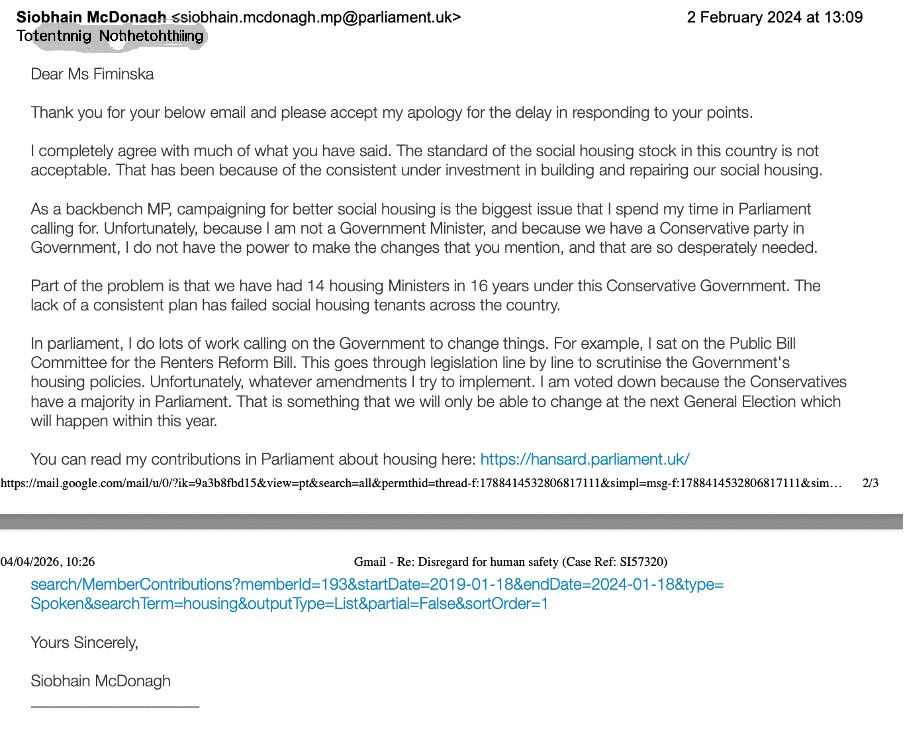
Later that day, I got an email signed by Ms McDonagh herself, saying that the standard of the social housing stock in this country is “unacceptable” because of “consistent underinvestment” in construction and repairs.
She went on to say that campaigning for social housing had been the “biggest” issue that she’d spent her time in Parliament calling for, but with the Conservative Party in Government, she couldn’t make any of the changes I was also calling for.
In her view, part of the problem was in the UK having had 14 housing Ministers in 16 years under the Tories. The lack of consistent plan had “failed” social housing tenants across the country.
Although Ms McDonagh herself sat on the Public Bill Committee for the Renters Reform Bill, as a backbencher, she could only scrutinise proposed policies and propose amendments. Unfortunately, she noted, the changes she’d been proposing were voted down. She concluded this could only be changed at the next General Election later that year (2024).
I suppose the implication being that a Labour Government would do a better job regulating landlords; whether this is the case remains to be seen. Their Housing Policy Pillars don’t include housing quality at the time of writing (spring 2026).
In response, I looked up Ms McDonagh’s work. She’d lived in the area her whole life and had been involved with housing projects from 1988 to 1997, chairing the borough housing committee between 1990 and 1995, according to her Wikipedia page.
She was involved in the rebuilding of another local social housing estate during that time, which was now also under the management of Clarion Housing. According to various Parliament records I could find upon a brief search, she was indeed involved with housing bills, but her time in Parliament by 2023 had been roughly split in half between Labour and Conservative Governments.
Given this was election year, I asked her why an MP’s office couldn’t put pressure on Clarion to carry our repairs in a timely, standard-compliant, and effective/sustainable manner. Clarion seemed to be spending money on various sub-contractors to carry inspections and repairs that achieved little to nothing, suggesting it was just the lack of money. And besides, whose money were they spending as a provider of social housing? Were they not at least part-funded by the public purse?
I received no direct response but the following week Ms McDonagh’s election campaign leaflet landed on my doormat. One phrase specifically caught my attention:
“Your Labour Action Team will always be ready to hold Clarion to account on your behalf.”
It goes on to say I should get in touch if I want to “help [them] make our community better”. They would “love” to have me on board.

Madness of London housing
In April 2024, when the election campaign was in full swing, I saw a video featuring Sadiq Khan, committing to working with housing associations across London to build more social housing.
On a whim, I emailed his office (he was still the Mayor of London), suggesting that he visits a Clarion-run estate and speaks to the residents about our experience of living under the company’s management before he undertakes any joint projects or invests any funds.
A spokesperson for the Greater London Authority replied that the Mayor had no authority to intervene in individual lease holder disputes and as such would not visit a residents’ assembly. Nevertheless, housing issues dominated that year's campaign.
According to the OnLondon election guide, the shortage of secure, affordable, good quality housing had “weakened” the capital, prompting London Councils, a body representing 33 of the city’s local authorities, to declare it an “emergency”.
Indeed, quick searches on Zoopla and other real estate listing websites at the time, showed that London, and especially the borough of Merton, had many properties listed for approximately £250,000 as “cash-only” properties for “investors”.
In London’s other extremities, this amount could buy studios in basements and attics with “windows” that peek right above the ground or out to the sky, respectively, or grow mould visible on seller’s pictures. Affordable properties included boats and converted sheds. Some flats had tenants “in situ”.
But having money didn't necessarily deliver from the wilderness that was the London property market in 2024. Even new “luxury” properties priced at close to a million pounds were falling apart. An example of this was a new-built property in Camden, were flats cost up to £900,000, but were deemed valueless due to defects that made them "unmortgageable" and uninsurable shortly after the buyers unpacked in their new homes in 2019.
Residents quoted in the press reported experiencing "sensations of movement beneath their feet" as though they were “on board a ship in choppy waters”. One woman reported being afraid of taking a bath in case the floor, which appeared very badly made, couldn’t support the weight of a tubful of water with her in it. According to the same article, the flat smelt of damp but the owners couldn’t find its source, which forced them to redecorate. The contractors hired for the works discovered wiring issues and reported water “gushing out of a socket”.
After a long fight, in January 2025, the Standard newspaper reported that the residents got a High Court ruling that the insurer should pay £1.5m towards repairs or rebuild works for the entire building with Camden Council acting as an enforcer. The parties agreed that the works would be completed by November 2027.
As I'm writing this, the London Assembly has launched a Social and Affordable Homes Programme for 2026-36, pledging £11.7 billion for projects that can start on site by March 2036 and complete by March 2039. At least 60% of homes delivered under this programme are expected to be for social rent though quality standards are unclear. Other “affordable housing products” under this scheme include social rent, shared ownership, and intermediate rent. Households are eligible for affordable housing, given a total income of under £75,000-80,000.
According to the Office for National Statistics, median annual income for London in April 2025 was £49,692.
Millions of UK homes not suitable for habitation
While increasing housing stock in London and Greater London may be needed, improving the safety of the existing homes should be considered equally important. Making existing homes habitable, including the properties currently unoccupied because of their poor quality, would increase the total available housing stock, while improving the quality of life of millions of people.
According to the English Housing Survey, in 2022-23, 3.5 million households (14%) in England lived in a home that failed to meet the Decent Homes Standard, 2.1 million households (9%) lived in a home with at least one Category 1 hazard, and 1.0 million households (4%) lived in a home with damp.
The Housing Health and Safety Rating System defines “Category 1” hazard as a “serious and immediate” risk to occupant health and safety, including excess cold, fire risks, structural failure, electrical hazards, and faulty gas appliances. The guidance is enforced by local authorities (councils) in England and Wales under the Housing Act 2004.
More than 1 in 10 dependent children in England live in “non-decent” housing. That’s approximately 1.5 million children living in homes that fail the Decent Homes Standard.
According to the same report, it would cost £9,266 to turn a “non-decent” home, including currently unoccupied properties, into one that meets the Standard.
When I bring this up, people often tell me that the homes in the state of greatest disarray are the ones that were built right after the 1950s. The implication being that they are old and thus cannot be expected to be in good condition in the 2020s. This is a strange explanation. Structurally sound buildings are subject to wear and tear; given proper maintenance, they should remain in good condition for decades.
The longevity of a building depends on several factors, including the materials used for the foundations, walls, and rooftops, which have different lifespans, ranging from 200-300, 100-150- and 50-80 years, respectively.
In Poland, where I was born, contemporary buildings are expected to last 50-100 years, with mandatory checks and repairs conducted annually and larger works delivered every five years. My grandfather has been living in the same flat since 1953, and the building remains in mint condition thanks to regular maintenance and modernisation works.
(Although this practice is being increasingly undermined by property developers who use low-quality materials to complete projects as quickly as possible to maximise profit margins from the sales of real estate. The practice has been dubbed patodeweloperka as a portmanteau of “patologiczna deweloperka” [patho-development].)
Cost of unsafe homes
Housing quality has tangible effects on people’s lives although the English Housing Survey notes marginal differences in the overall and mental health between people living in decent and non-decent homes.
(People rarely know they’re being abused while they’re being abused, and having no option to move elsewhere can make us engage in mental gymnastics to obfuscate the reality of our situation from our conscious mind, which perhaps helps explain the findings of this report.)
A 2022 Parliamentary report suggests a causal link between poor housing conditions and poor health outcomes, citing the 1846 Nuisances Removal and Disease Prevention Act, which was one of the first pieces of policy establishing housing procedures to curb cholera spread. Further public health acts followed in 1848, 1872, and 1875 to establish sanitary authorities and require new housing to have proper drainage and running water.
In 2010, the Marmot Review said that housing is a “social determinant of health”, linking poor-quality housing to respiratory conditions, cardiovascular and communicable disease, and increased mortality. Children living in poor-quality housing are at increased risk of poor health, low school attainment, and behavioural problems.
The 2021 Building Research Establishment report estimated the cost to the NHS of treating those affected by poor housing as £1.4 billion per year (the most costly issue was identified as excess cold) although I’m unclear how this cost was separated from the effects of covariates that inevitably correlate with living in poor quality homes, like poverty, smoking, exposure to asbestos, and disabilities, including mobility issues. For context, costs associated with treating lifestyle-related illness (obesity, smoking, diet, including type 2 diabetes), have been estimated at £11 billion annually.
The Building Research Establishment report identifies excess cold as the key driver of poor outcomes and expenses. Cold is linked to dampness, which is linked to mould, which can cause serious illness and death.
Children die at home
In 2020, Awaab Ishak died at the age of two from a respiratory condition, which a coroner ruled was caused by prolonged exposure to black mould in his home which had “inadequate ventilation and was not equipped for normal day-to-day living activities, which led to excess damp and condensation”, according to the inquest.
The death led to a change in policy, known as Awaab’s law, introduced via the Social Housing Regulation in 2023, and affecting social housing providers, expected to be rolled out in full scope by 2027 when it will affect the private sector.
The changes require that landlords investigate complaints within ten days of damage being reported and repair the damage within five working days after their investigation ends. A written summary must be given to the tenant within three working days, and relocation must be offered if the house remains unsafe.
My experience with how Clarion Housing fails residents makes me suspicious of how enforceable these timelines are, given that, at the time of my last complaint, they’d been looking for the source of various leaks for about twelve years. I imagined this could only encourage their practice of “inspecting” problems and corresponding with tenants about the “efforts” taken to diagnose and fix the issue, which would never be achieved.
I also wondered where I’d sit under this new policy while living in my sister's flat. My sister was a leaseholder on a Clarion estate; she owned the flat rather than rent it from Clarion, which had already put us in a no-man’s land between the Housing and Property Ombudsmen, and I wondered whether we would have fallen outside this new policy had we still lived under Clarion Housing management at the time of its arrival.
Plus, my understanding of the policy suggested that it applied to inside the flats—what about communal areas, which fell squarely under Clarion’s remit, and which were riddled with safety hazards?
I also wondered about the quality or sustainability of the mandated mould-related repairs. The policy didn’t require that all residential buildings be insulated, temperature-controlled, and ventilated, which would involve expensive construction work, but could effectively prevent cold, damp, and mould from setting in, increasing the overall energy efficiency of the buildings.
Britain has been reported to have some of the most poorly insulated housing stock in Europe, which was supposed to change under policies introduced to meet the UK’s climate commitment of reaching net-zero emissions by 2050. During his time as Prime Minister, Rishi Sunak said this was “too much” for people. He made a U-turn on this policy, announcing that he wouldn’t require homeowners or landlords to meet energy efficiency targets, making insulation “optional”.
The Great British Insulation Scheme, a voluntary programme which ran until March 2026, provided grants to support people with the costs associated with privately insulating their homes. Housing associations were not part of the scheme, and I wondered whether landlords would be allowed to continue the practice of painting over the mould and calling it “fixed”.
Your house will kill you
Since the 2022 ruling on Awaab’s death, several other cases of deaths from respiratory conditions among tenants living in mouldy council flats have been brought before UK courts, which acknowledged toxic homes as a contributing but not causal factor in grave outcomes.
According to a paper by Clark et al. (2023), cited by the UK Health Security Agency, exposure to damp and/or mould was associated with approximately 5,000 new cases of asthma and approximately 8,500 cases of lower respiratory infections, causing affected people a total of 2,200 and 600 days of illness, respectively (estimates for 2019).
The authors noted that using other data sources to estimate the number of houses affected by damp and/or mould could make these estimates three-to-eight-times higher. In their conclusion, their findings highlight the public health importance of “good indoor air quality and good quality housing."
I can provide a case study.
During the two years I lived under Clarion Housing, I developed allergies the intensity of which I’d never experienced before or since (or while away from London as a matter of fact).
In the summer of 2023, my right sinus filled with mucous that glided slowly down the back of my throat, and which I couldn’t blow out of my nose. After a couple of weeks, lumps of mucous clogged the Eustachian tube, sucking in the ear drum, making me lose a significant portion of hearing in that ear. I could barely hear myself on that side and the sounds coming in from the outside were so muffled that during meetings I had to lean in with my left ear. This initially lasted for three weeks, during which I was so unwell, I could barely function.
I went to Poland for a couple of weeks, where I was treated by an ENT with a mild decongestant and a ten-day dose of nasal steroids. Everything was fine until I got back to London where my ear was blocked again within just a couple of days. Having to wait days for a GP appointment, I tried to self-treat by repeating the course of decongestant+steroid, using leftover medication, but that only made things worse. When I was finally seen by a GP, I was prescribed what my pharmacist called a “really high” dose of antihistamines, strong steroids, and saline rinses.
Despite treatment, the problem never seemed to go away, persisting during the winter. Even on days when my hearing was fine, which it often wasn’t, I still felt the mucous move inside the ear whenever I moved my head, making me touch the ear all the time just to check whether something was oozing out of it. On “good” days, I felt the ear struggling to regulate the pressure, which was unpleasant, but all of this would typically improve when I was away, mostly resolving the first winter after leaving Clarion.
Thereafter my symptoms morphed into something else and eventually resolved with saline rinses.
Given this course of illness, I’d argue that living under Clarion Housing didn’t cause the allergies, but it did indeed cause them to intensify, contributing to my inability to function. But distinguishing between causal and contributing factors is always complex and, in this case, rather silly, in my opinion.
In public health, we’re looking at exposures and outcomes in a population, which contrasts with clinical medicine, which looks at an individual. A person who had smoked their whole life and presents with lung cancer may have disease caused by cigarette consumption. But not everyone who smokes gets cancer and not everyone who gets cancer smokes. Indeed, many people who smoke do get cancer, as do many people who just sit next to someone smoking or live in a room where someone had smoked for years. The more people are exposed, the more people got ill. On a population scale this contribution was eventually enough to ban smoking in public spaces. A similar logic may apply to mouldy housing.
Clarion fakes fire safety
By springtime 2024, it rained less, and the leaks appeared to be on pause. But Clarion works on the estate continued and now we were to face the question of fire safety.
Several years before, Clarion had replaced all the front doors to flats (but not the emergency doors) with ones that were supposed to meet fire safety regulations.
In Spring 2024, further works were required because it had come to light that some of the doors were “missing the fireproofing,” as explained to me in an email from the Residents’ Association, members of which were refusing access to their properties until they were given further details about this.
The engineer who came to my house explained that the door was fireproof, but the doorframe wasn’t, at least in some flats, which now required a replacement to ensure compliance with regulations.
I thought about the Grenfell Tower fire.
I emailed Scott Greenshields, a Clarion employee who had been handling the correspondence about these repairs, and Ms McDonagh, asking what this was about, and thereafter I continued to email requests for an explanation for three weeks. On one occasion, I wrote an email while a mouse ran across the floor in the living room.
Eventually, I got an email from Mr Greenshields, explaining why he delayed getting the requested information back to me, and assuring me that all my complaints had been logged: Leaks were being investigated; ventilation replacement work was underway and should address issues of mould and condensation, which should also have a “positive” impact on mice accessing my property.
The ventilation works had been going on for at least three years; as I wasn’t living on Clarion grounds at the time they started, I chose to leave them out of this piece; suffice it to say, when I moved out of the Clarion flat in September 2024, ventilation wasn’t working.

Around that time, my sister and I got a timeline for moving out, and I saw a bright light at the end of a very long tunnel. I couldn’t fight anymore a battle I couldn’t win just to stand on principle. My allergies were savage and the anxiety from not knowing whether the blocks would still be there next time I came home was now all-consuming. I told myself to stop. I’d be moving soon. In another few months all this would be behind me. I should conserve energy for packing.
Then one evening I heard what sounded like a shower running outside my emergency exit door (the one that didn’t comply with fire safety regulations). I pushed it open, careful to not let it shut behind me. I stepped into the short hallway and followed the sound of the waterfall to the exit door where a rusty pipe was foaming around what must have been a hole that kept the water running.

Close to tears, I returned to the flat, noticing the sign at the back of my upstairs door that said: Emergency door. Keep clear.
Once inside, I sent yet another email, describing the damage and asking Clarion to repair it.
The shower outside the door continued for days, prompting a neighbour to pull up a tall rubbish bin and put up a sign asking people not to remove it, so it can gather the water flowing from the broken pipe above.

One quiet evening, I wanted to see if the leak had been fixed. I moved the latch on the emergency door and…couldn’t open it.
Over night, the ceiling had been lowered to a height where I could place my hand flat on it while standing with my feet flat on the floor. As a result, the top of the door got caught, cutting off my emergency exit, making my mind loop on the Grenfell Tower fire.
Clarion employee said they were “looking” for a solution. I don’t know how far and wide they needed to look; they’d boxed in the new gas pipes that were running along the ceiling. In doing that, they reduced the ceiling height to below two meters.

I shared my predicament with a friend, who told me to call the fire brigade. They were responsible for fire safety. They’d take this seriously. And so I called the fire brigade and logged my concern with the person who took my details. I got a call back an hour later.
I explained my situation: I lived in a split-level flat and my emergency door, which was upstairs where the bedrooms were, had been functional until the day before. Now it was blocked by a very low ceiling, which had appeared overnight, making it impossible to evacuate from the upper floor.
The man asked me how many exits out of the flat I had. At this stage, I didn’t even know how to answer the question; he clarified, asking how many ways I could take out of the flat now, safely.
Quite honestly, I didn’t know if there was any safe way out of the flat, let alone out of the building, everything seeming to me particularly vulnerable to any Clarion employee lighting a cigarette during their break. Eventually, I said I could take the exit through the main door, downstairs. It was the second upstairs emergency exit had been blocked.
I heard the man say it didn’t matter.
Provided I had one unobstructed way out of the flat, it was all fine. He understood about the split-level flats, he assured me, adding that he could despatch a team now and they’d dismantle my emergency door to ensure a safe passage, but that would cause me other problems, like security the property, which he didn’t think I’d want.
I had to agree though I couldn’t grasp why it was my door that had to come off the hinge when it was Clarion that had lowered the ceiling to below the (supposedly) required minimum of two meters in the stairway—what responsibility did they have in keeping unobstructed the door that they themselves designated as an emergency exit?

In 2025, SkyNews reported that Clarion Housing had been faking fire safety notices after revealing a recording of a conversation between a manager and an employee. During the conversation, a manager from Clarion is heard saying, “Don’t tell anyone I told you this,” before instructing an employee on how to pretend he’d put up an important safety notice in a building in their care.
The fire safety notice being discussed in the recordings was a poster advising residents with disabilities or vulnerabilities to contact Clarion. The need for a building owner to identify people who would need additional help in the event of a fire was part of compliance with new regulations introduced since the Grenfell Tower fire in 2017, which killed 72 people.
Residents with disabilities and vulnerabilities must be identified so that a “person-centred fire risk assessment” can be drawn up by the building owner. Those documents should then be stored in a box on the ground floor in high-rise buildings so firefighters can easily access them in an emergency. The article goes on to quote an expert who acknowledges that fire-safety failures are industry-wide.
Other news outlets picked up the story, which gained some traction on social media, mostly among Clarion residents, with some engagement from Grenfell Tower survivors. The Ministry of Housing condemned the incident, stating that those breaching fire safety laws face criminal prosecution and then…nothing happened.
At least nothing that I could find—let me know in the comments below if you know of Clarion Housing facing any consequences for breaching fire safety regulations.
Grenfell Tower inquiry report
But then not much changed after the Grenfell Tower fire of 2017, which killed 72 people.
An inquiry into what happened and why was only convened after a successful campaign by Grenfell United, led by the survivors of the fire, whose petition was signed by 150,000 people. According to their website, this “forced” then Prime Minister Theresa May to convene a panel.
The report, whose second phase was released in September 2024, exposed the culture of complacency, cost-cutting and institutional failures that led to the Grenfell Tower fire—from manufacturers knowingly selling dangerous products, to regulators failing to protect residents.
But eight years later, at the time of SkyNews reporting in 2025, a new competence and conduct standard for social housing was yet to come into force and would not be fully implemented for another three to four years.
Edward Daffarn, who survived the Grenfell Fire, told SkyNews: “The only conclusion I can come to is that those in power, those people who have the power to make the change necessary, really don’t care enough about the people that live in social housing.”
A statement published on the Clarion Housing website reads: “Fire safety is one of our top priorities at Clarion, and as the UK’s largest social landlord, we take our responsibility to keep residents safe extremely seriously.”
In November 2025, the Housing Ombudsman, fined Clarion £450 payable directly to the resident filing a complaint over fire safety concerns (a fire alarm-related issue) and the company’s handling of these concerns.
Biggest provider of social housing
The Clarion Housing Group is the UK’s largest housing association, a major home builder, and an investor in people and places, according to the company website. They “provide homes” for those who “need them most” and have 360,000 residents across the UK, making it the nation’s biggest housing association. They’re a “business with a purpose” with a reported annual turnover of £1.087 billion.
According to their annual operating report, in 2024/25, they spent £417 million on improving and maintaining homes, achieving 84.7% customer satisfaction. It is unclear what percentage of Clarion-provide homes meets the Decent Housing Standard.
The report states: “We [embed] a positive complaint handling and learning culture within the organisation—one that treats our residents with empathy, transparency and respect.”
As I scrolled through the report, I saw pictures of happy-looking people and I wondered how much could have changed in the time between I lived under Clarion and when this report was published. I couldn’t imagine any of my neighbours appearing in any of these images.
We had contended with mould, leaks, unsafe gasworks, which had to be replaced, and all this in just fifteen months. We had other, longer-standing issues, too, like the ventilation that didn’t work, flats with naked concrete floors, and double-glazed windows installed in a way that left space between the window frame and the wall or floor, allowing water to glide into the room when it rained (not the mention the constant draught and increased energy costs).
There was the elevator that often didn’t work, leaving people with mobility issues trapped in their flats, and now also emergency doors that didn’t open because the ceilings placed to box the new gas pipes were too low.
This says nothing about people's personal circumstances, including single mums with three kids living in council-allocated one-bedroom flats, or older people with illness and disability living on their own and unable to heat the flat to the recommended 20-22 degrees Celsius.
Laughter isn’t a medicine
In the summer of 2023, at the peak of my housing issues, my boss assigned to me an article titled: Laugher is the best medicine. In the post-pandemic drive to give people tips on improving their mental health, the article’s intention was to help boost the wellbeing of people living with chronic health conditions during the winter months.
I had many objections to the premise of this piece—we were heading into a winter that was marked by a cost-of-living crisis during which public utility buildings were open to people who couldn’t afford to heat their homes—but I was feeling particularly low at home so wanted to do well work.
After a lot of discussion, I eventually delivered the piece, which read to my colleague as something I "really didn't" want to write. My boss described the experience of my working on it as "full of friction". Her boss, who hadn't read the piece, said the article showed the job "wasn't for [me]". They were right. I resigned.
The experience haunted me for a long time, with the three colleagues appearing in my dreams, in which they pushed me out of a car driving down the cobblestone streets of Old Town in Edinburgh. I'd wake up terrified that I'd have to see them at work. Once I'd realised it had only been a dream, I wondered what this said about me and about my career prospects.
I'd been hired for an ability to combine personal narratives and medical evidence into stories about health and disease. I didn't want to write that laughter is the best medicine because... medically, it isn't.
In that role, I was writing for people contending with record-breaking waiting times for treatments and procedures that were the legacy of the pandemic, straining the NHS resources. On top of that, we were living through a cost of living crisis, which left many people too poor to heat their homes, if they still had them, as the rates of evictions in London spiked. Plus, my life under Clarion had taught me that having a home in the UK didn't mean we had anywhere to live.
In this context, a national organisation dedicated to science and research to benefit people with a chronic condition recommending laughter as the best medicine felt to me like... Clarion saying they were "investigating" the leaks which continued to drip for years.
Laughter may be the best medicine when no real medicine is required. When things are already good enough but we just can't see it, or when nothing else can be done, and we must make the best of the hand we’d been dealt. But illness often requires effective medicine and housing often requires sound engineering; both require equitable policies.
Poor quality housing in the UK may seem like a bad hand most of us had been dealt. Many of us have become apathetic when dealing with cold, mould, and mice that have infested our homes. We may be laughing in despair, but in this case the best "medicine" is a collective demand of policy that ensures housing standards are high, observed, and that residents’ and councils have the (legal) power to enforce them.
How about you? Have you experienced housing issues? Share your stories in the comments below.


The local councillors have confirmed, the new estate on the sight of the gas works, will have 100 flats for social housing tenants, as apparently, the cost of decontaminating the land was too expensive for the constructor, and council have paid in advance for these 100 flats allowing the decontamination works to be finalised. Some people during the first school half term this year, suffered with cold and flu like symptoms and a foul taste. When the council were approached regarding air pollution readings, instead of a registered entry of test levels, the council sent photos of a hand held monitor from the following week.
Where we are:
1) 2004 Housing Act violations: The council created a task and finish action group after the pandemic with councillor Dan Johnson representing Merton. The group was supposed to oversee Clarion’s repairs, which have been long overdue, and paused altogether during the gas emergency. The items on the list included ventilation shaft repairs and stair edge painting for safety. Clarion received a repairs order from the residents’ association, from which they only managed to paint stair edges. The stairs are now even more slippery than they were before.
2) Fire safety failures: The emergency exit doors can’t be used in most flats. Clarion was alerted to this in 2024, during the gas and ventilation works, which boxed in the…
This is Clarion in June 2026:
Clarion violate the Equality Act by refusing to make adjustments for people with disabilities.
They increase service and rent charges, which are being disputed, as they seem to have different "tariffs" for different people.
They're trying to get back the money they spent on the gas emergency, which they said they never would.
They don't keep the lifts running, so people who live at top floors can't come and go from home.
Residents are taking action and are move united than ever before!
If we are not shocked reading this, we should be worried. The drip-drip effect might mean that we normalise the situation and think that there isn't anything we can do. While I don't want to take the focus away from housing here, it also made me think about the state of other services in this country, be it healthcare, public transportation or drinking/waste water management.
Coming back to the issue of unacceptable living conditions, the battle of the affected individuals to be heard (first of all) seems so lonely, often maddening and impossibly long at times. But the voices are getting stronger and they are echoing one another.
I read about a similar experience by Kwajo Tweneboa:
https://top100influentialpeople.com/winner/kwajo-tweneboa/
Reading your…
Thank you for this really interesting article. Sorry you had to go through this nightmare, but I know so many people who have similar stories unfortunately. Damp in particular, as you have pointed out, is an ever present worry on our weather swept island and something that all housing stock should be built to prevent. Poor insulation, terrible energy efficiency and poor quality (as well as the growing obsolescence) of gas heating are all also huge issues still suffered by properties in the UK, but that most of mainland Europe seem to be addressing effectively.